
Why most AI projects create no lasting advantage
The AI illusion
Most AI projects produce copyable features. GENOME™ distinguishes additive AI from constitutive AI that accumulates advantage over time.

Hakim Lourguioui
Creator of the GENOME™ AI Framework
Published July 10, 2026 · 5 min read
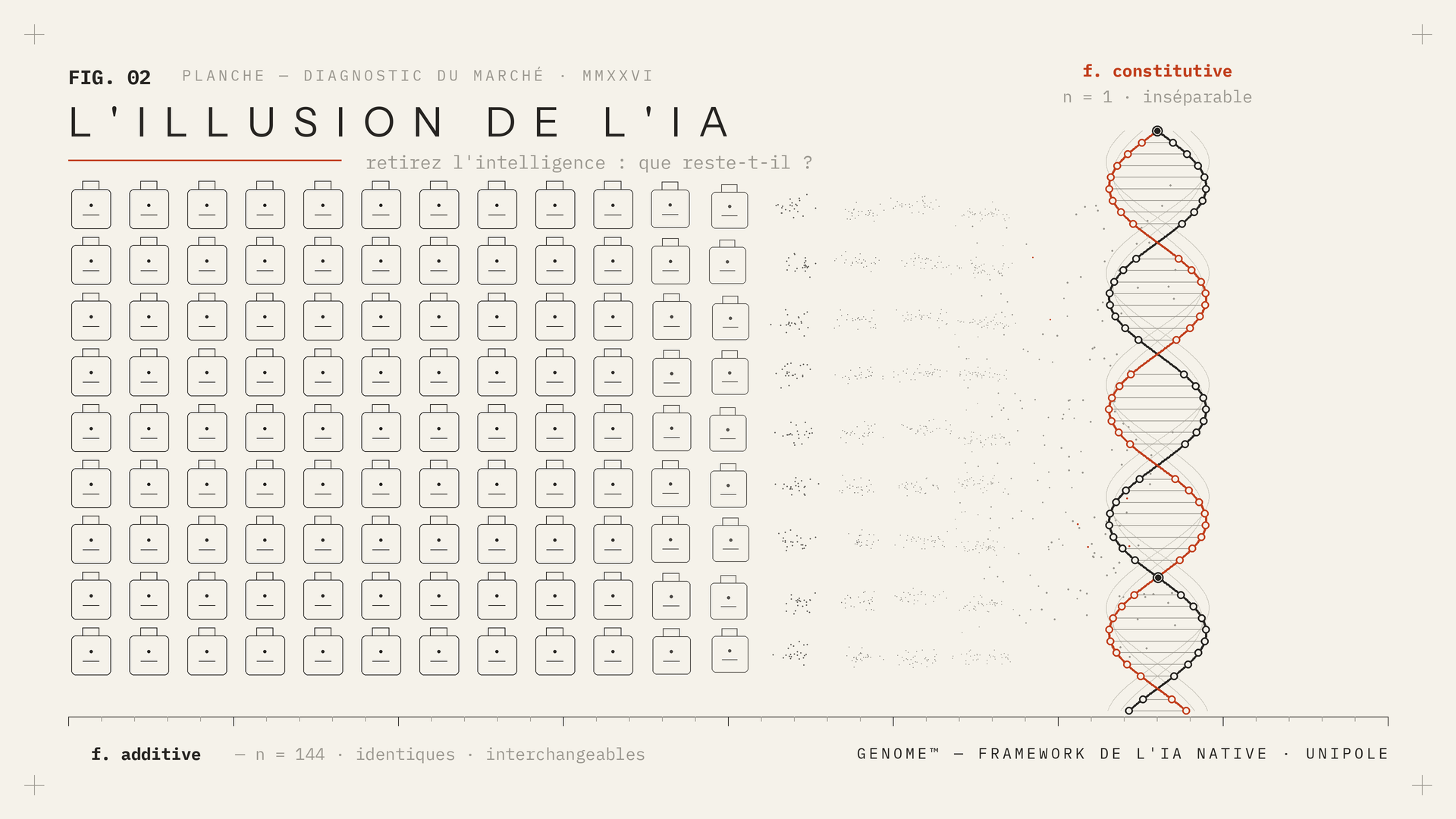
A few days ago I asked: if you remove AI from your product, what remains? Many people answered privately with the same discomfort: “a perfectly functional product”. This article explains why that discomfort is justified.
The paradox everyone senses but no one names
Companies have never invested more in AI. Yet how many of those projects created an advantage competitors cannot reproduce within weeks?
The honest answer is: very few. Most enterprise AI projects produce features, not advantages. A feature, by definition, can be copied.
The illusion unfolds in three acts.
Act 1 — Everyone rents the same brain
When your “AI” is a call to the same model used by competitors, with a slightly different prompt, you have not built an asset. You have purchased a subscription. The model provider owns the intelligence; you own an invoice.
Renting a large model is often the right technical choice. The mistake is believing that the rental itself creates differentiation.
Act 2 — The demo impresses, the quarter disappoints
Grafted AI features have a cruel property: perceived value peaks on demo day and then declines. The chatbot that dazzled the executive committee in January becomes invisible by June.
Nothing happened between the two moments. The tool learned nothing specific about your company, customers or data. It is as generic on day 180 as it was on day one.
A competitive advantage is the opposite: something that becomes more valuable with every passing month.
Act 3 — A competitor connects the same module
This is the logical ending. If your AI can be separated from your product, anyone with access to the same APIs can reproduce it — meaning everyone.
Your “lead” is measured in roadmap weeks, not in years of accumulated learning.
What distinguishes the exceptions
Products where AI forms a genuine fortress share one pattern across industries: the system learns something unique about every customer, use and interaction, and that learning feeds the product itself.
Every day of operation widens the gap. A competitor copying the feature cannot copy years of accumulated understanding.
This is the difference between a feature and an organism, additive AI and constitutive AI, a module and DNA.
I observed this pattern across twenty years in IT and dozens of Unipole engagements, often enough to formalise it through GENOME™.
The question for your next AI committee
When the next AI project reaches the table, do not ask only “what does it do?” Ask:
- What will this system have learned from us in six months?
- Is that learning reused to improve the product?
- Can a competitor with the same APIs catch us within one quarter?
If the answers are “nothing”, “no” and “yes”, you are buying a feature rather than building an advantage. That may be acceptable, but make the choice knowingly.
Is your system ready to learn?
Use the GENOME™ DNA Test to prepare a structured diagnosis.
Take the DNA Test