
AI in your product: grafted on or embedded in its DNA?
Why I created GENOME™
Why GENOME™ formalises the difference between AI added as a feature and constitutive intelligence embedded in the product itself.

Hakim Lourguioui
Creator of the GENOME™ AI Framework
Published July 10, 2026 · 6 min read
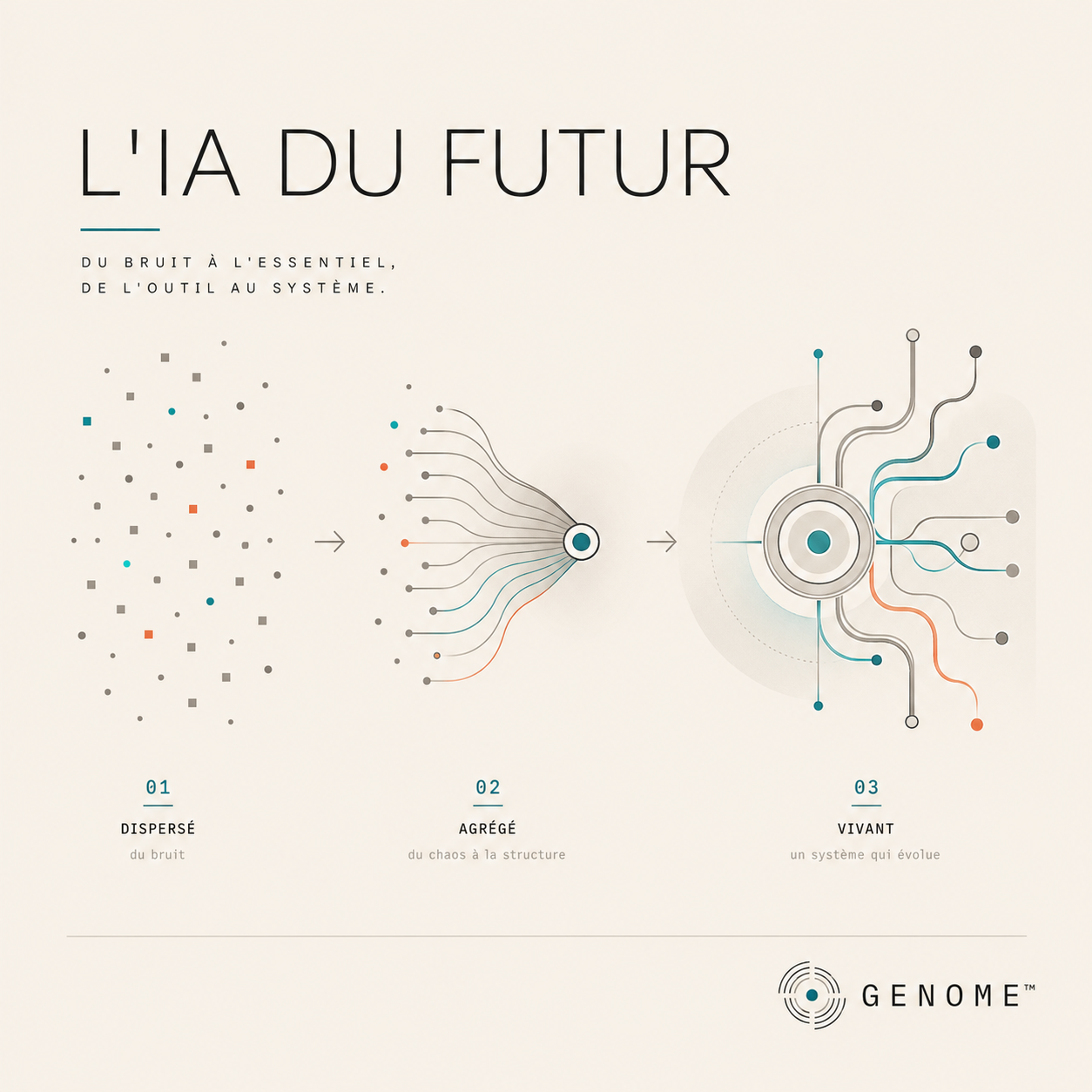
For the past two years, I have watched the same scenario unfold in the companies I advise: a chatbot, recommendation module or writing assistant is added, and the result is called “our AI strategy”.
Six months later, the conclusion is almost always the same: the tool works, but nothing fundamental has changed. A competitor can connect the same module in two weeks. No lasting advantage has been created.
The problem is not the technology. It is the architecture of the thinking.
A one-question test
This is the question I now ask every executive or product leader I meet:
If you remove artificial intelligence from your product, what remains?
If a perfectly functional product remains, then your AI is an accessory. It has been grafted on. It may add convenience, but it neither constitutes your product nor protects it.
Now consider products that dominate their category through AI: remove their intelligence and nothing usable remains. AI is not a feature there. It is constitutive. It is in the DNA.
That is precisely the difference between an organism and an object with sensors attached to it.
Why “GENOME”
After twenty years in IT and dozens of AI integration projects through Unipole, I formalised what I had observed in the field into a framework called GENOME™: Growing Engine, Natively Orchestrated, Moat-Embedded.
The genomic metaphor is not decorative. A genome is what enables an organism to:
- express itself in every cell rather than in one isolated organ;
- learn from and adapt to its environment over time;
- transmit and reinforce what it learns from one generation to the next.
An AI-native product works in the same way: intelligence is pervasive, it learns from every interaction, and each learning event makes the product harder to catch.
This turns AI into a cumulative competitive advantage — a moat that deepens by itself — rather than an interchangeable gadget.
Graft, integrate, or design natively
GENOME distinguishes several maturity levels between “AI layered on top” and “constitutive AI”. Most products described as AI today remain at the first level. Some reach the second. Very few are genuinely native.
That is good news: in most industries, the position is still open.
The framework provides a complete method for moving through these levels: identifying a product’s central intelligence, designing learning loops and objectively assessing its current position.
I will explore some of these elements in future articles; others remain part of the work we deliver through Unipole engagements.
What comes next
This is the first article in a series. Upcoming topics include:
- why most enterprise AI projects create no defensible advantage;
- the three AI paths — graft, integrate, rethink — and how to choose;
- applying the DNA Test to products you use every day.
If this resonates with you as an executive, CTO or product manager, follow the series or speak with us directly.
GENOME™ is a framework created and formalised by Hakim Lourguioui and deployed through Unipole consulting engagements. © 2026 — All rights reserved.
Is your system ready to learn?
Use the GENOME™ DNA Test to prepare a structured diagnosis.
Take the DNA Test