
What truly changes under the hood
The principles of AI-native systems
AI-native systems are defined not by visible AI features, but by how intelligence organises the product, captures signals, learns and compounds advantage.

Hakim Lourguioui
Creator of the GENOME™ AI Framework
Published July 10, 2026 · 6 min read
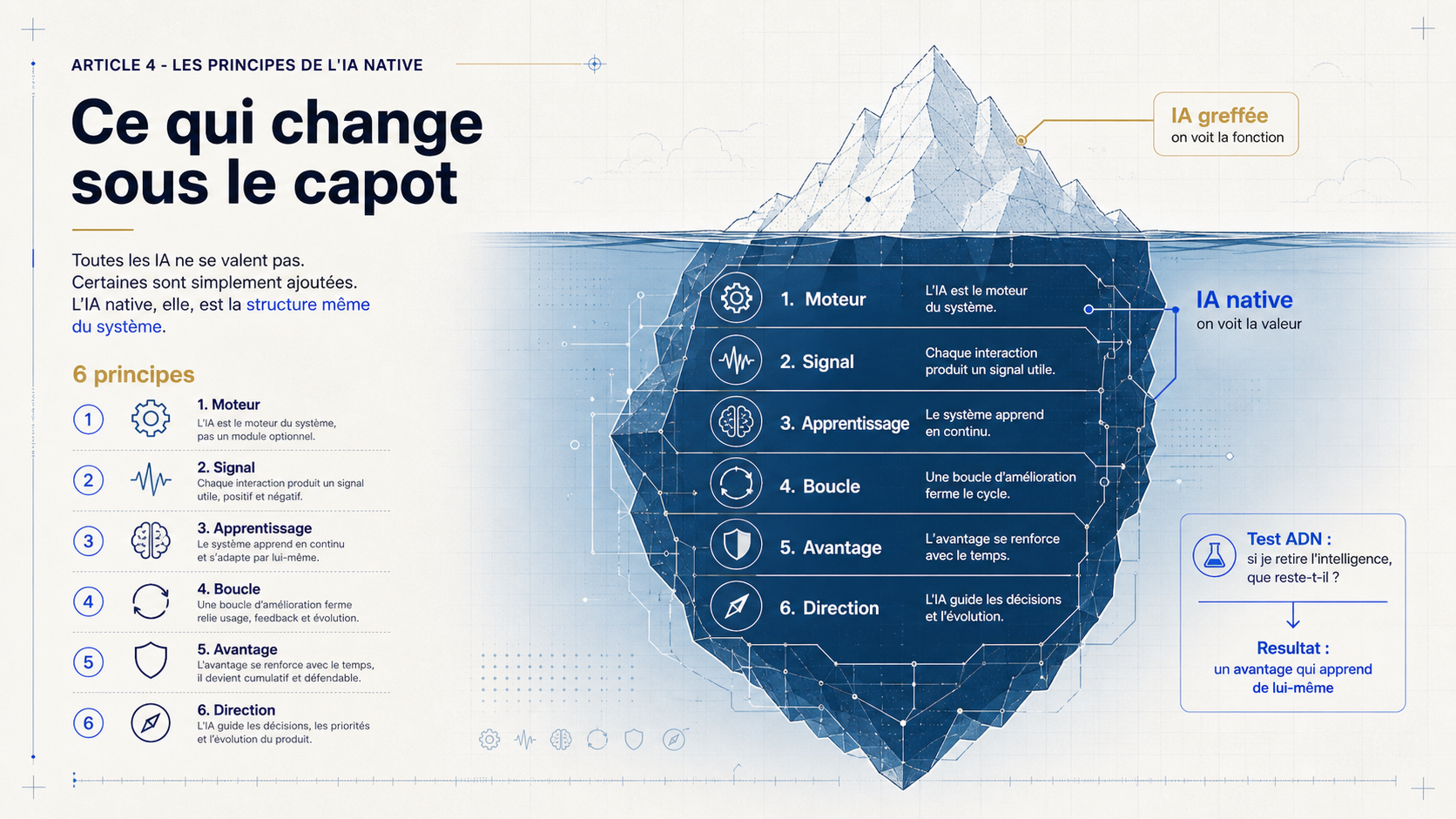
The previous articles distinguished three paths: graft AI onto a product, integrate it, or rethink the product around intelligence. This distinction raises a more precise question: how can we recognise genuinely native AI?
The answer is not found in the number of visible AI features. It lies under the hood: in architecture, data, signals, learning loops and the product’s ability to improve through use.
1. AI is the engine, not an option
In an AI-native product, intelligence is not a button added at the end of the chain. It is the reason the product exists.
If removing AI leaves almost the same value, the intelligence is probably grafted on. If the product loses its meaning, we begin to reach the native level.
2. Every interaction becomes a signal
A native system does not merely record data. It turns usage into actionable signals: clicks, hesitation, corrections, rejections, preferences, sequences and explicit or implicit feedback.
Nothing is incidental. Every interaction enriches the system’s understanding.
3. The product learns and adapts
Learning must not remain hidden in a technical report. It should progressively change the experience, recommendation relevance, decision accuracy or journey efficiency.
Today’s product should not be exactly the same as yesterday’s product.
4. The improvement loop is built in
Native AI operates as a loop: usage, signal, learning, improvement, then a new signal. This loop is not an add-on; it is the heart of the system.
That is what separates an intelligent feature from a product that genuinely progresses.
5. Advantage strengthens over time
A genuine AI advantage is not measured only at launch. It is measured by its ability to deepen through use.
The more the system is used, the more it understands. The more it understands, the more relevant it becomes. The more relevant it becomes, the harder it is to catch.
6. AI guides product evolution
In a native product, AI does not merely improve what exists. It influences priorities, product decisions, future services and evolutionary paths.
The product evolves from what the system learns, not only from hypotheses made in advance.
The DNA Test does not lie
The central question remains deliberately simple: if I remove the intelligence, what remains?
If a complete product remains, AI is probably grafted. If a degraded but usable product remains, AI may be integrated. If nothing coherent remains, intelligence is in the DNA.
Designing native AI is not about adding AI. It means rethinking the product as an organism that learns, improves and accumulates its own advantage.
This is the logic formalised by GENOME™ and assessed pragmatically through the Unipole DNA Test.
Is your system ready to learn?
Use the GENOME™ DNA Test to prepare a structured diagnosis.
Take the DNA Test