
The three paths to enterprise AI — and how to choose yours
Graft, integrate or rethink
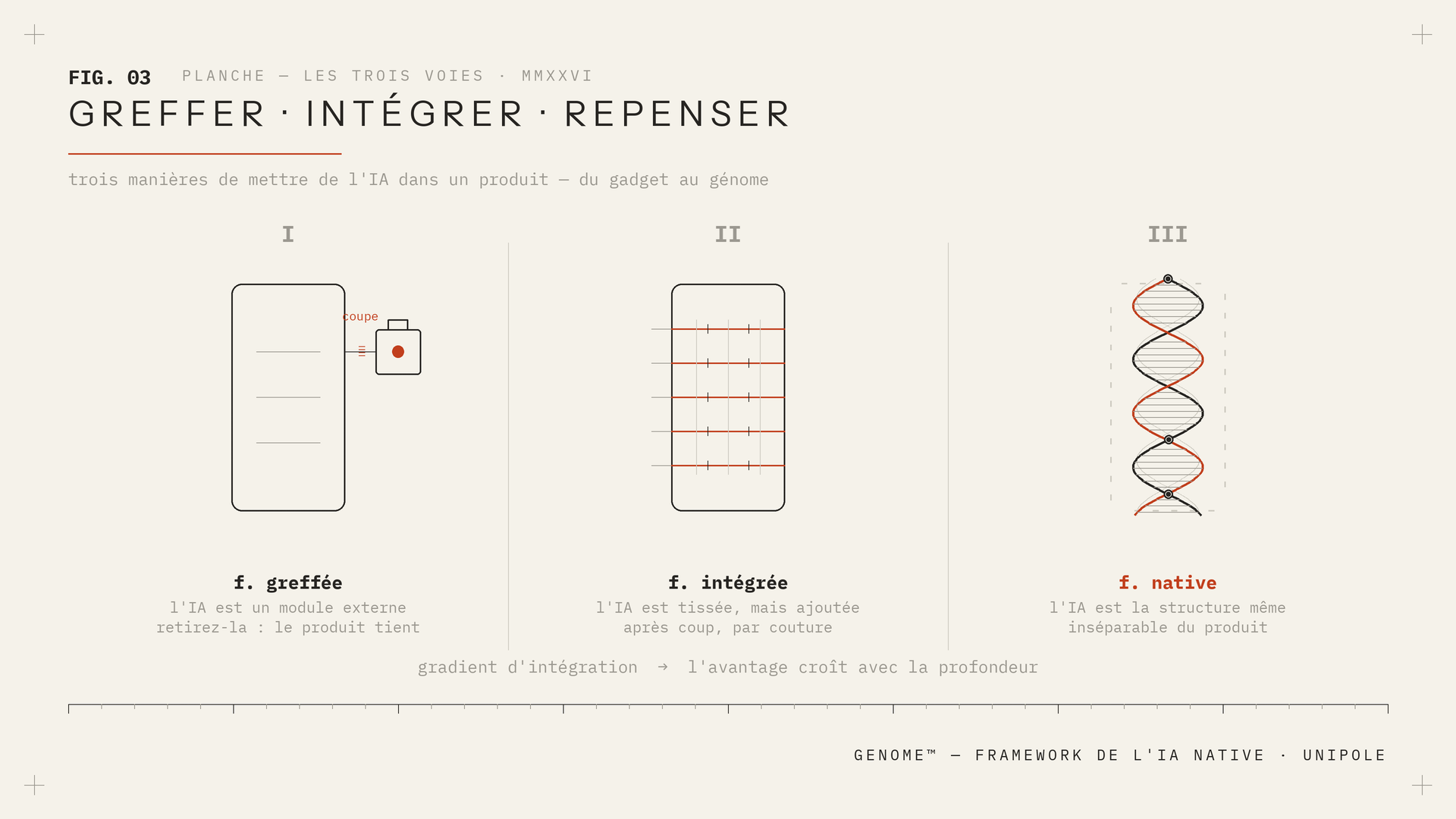
Between AI layered on top and AI embedded in the DNA lies a gradient. GENOME™ defines three paths: graft, integrate or rethink.

Hakim Lourguioui
Creator of the GENOME™ AI Framework
Published July 10, 2026 · 6 min read
In the previous articles I argued that AI grafted onto a product creates no lasting advantage. Several readers responded: “Fine, but what do we actually do? Must we rebuild everything?”
No. That is the purpose of this article.
Between AI layered on top and AI embedded in the DNA there is no wall. There is a gradient: three paths, from least demanding to most transformative. The right decision is not always the most ambitious; it is the one that fits your situation.
Path 1 — Graft
AI is an external module connected to a product that already works without it: a website chatbot, an automatic summary or an end-of-chain recommendation.
- When it is right: a tactical need, short deadline, limited budget or validation of a use case before investing. Grafting is fast and low-risk.
- What to know: you are buying a feature, not an advantage. It is copyable, and that is accepted. The trap is mistaking an accessory for an AI transformation.
Path 2 — Integrate
AI is woven into several points of the product, but remains an after-the-fact addition. The product was designed without it and AI was stitched into existing flows.
- When it is right: a mature product, a genuine desire to differentiate and legacy technology that cannot be discarded. This is the reality for most established companies.
- What to know: integration creates real value and makes copying harder, but the seams remain visible. AI improves the product without redefining it.
Path 3 — Rethink
AI is no longer an addition; it becomes the organising principle. The product is designed from the outset around what the system learns. Remove the intelligence and nothing usable remains.
- When it is right: a new product, a new market or a deliberate ambition to build an advantage even large competitors will struggle to catch. This is the native path.
- What to know: it is the most demanding path and the only one that produces an advantage which deepens by itself over time.
The trap to avoid
The greatest mistake is not choosing the wrong path. It is believing you are on path three while remaining on path one.
Many companies consider themselves AI-native because they have multiplied AI features, even though each remains a separable module.
If you remove the intelligence, what remains? The answer tells you which path you are actually on.
How to choose
Three questions quickly clarify the decision:
- Must this product become a defensible advantage, or merely stay competitive?
- Can I design it from scratch, or must I work with what exists?
- Am I prepared to invest for a return that compounds rather than arriving immediately?
There is no shame in grafting. The danger lies in deceiving yourself about what you built.
GENOME™ formalises this gradient and provides a method for locating a product on it through the work I deliver with Unipole.
The next articles examine the mechanics: how to recognise genuinely native AI when you see it.
Is your system ready to learn?
Use the GENOME™ DNA Test to prepare a structured diagnosis.
Take the DNA Test