
From dormant data to signals, then to living memory
Your company has data. That does not mean your AI can learn.
Many companies believe they are ready for AI because they have data. But stored data is not necessarily a usable signal.

Hakim Lourguioui
Creator of the GENOME™ AI Framework
Published July 10, 2026 · 12 min read
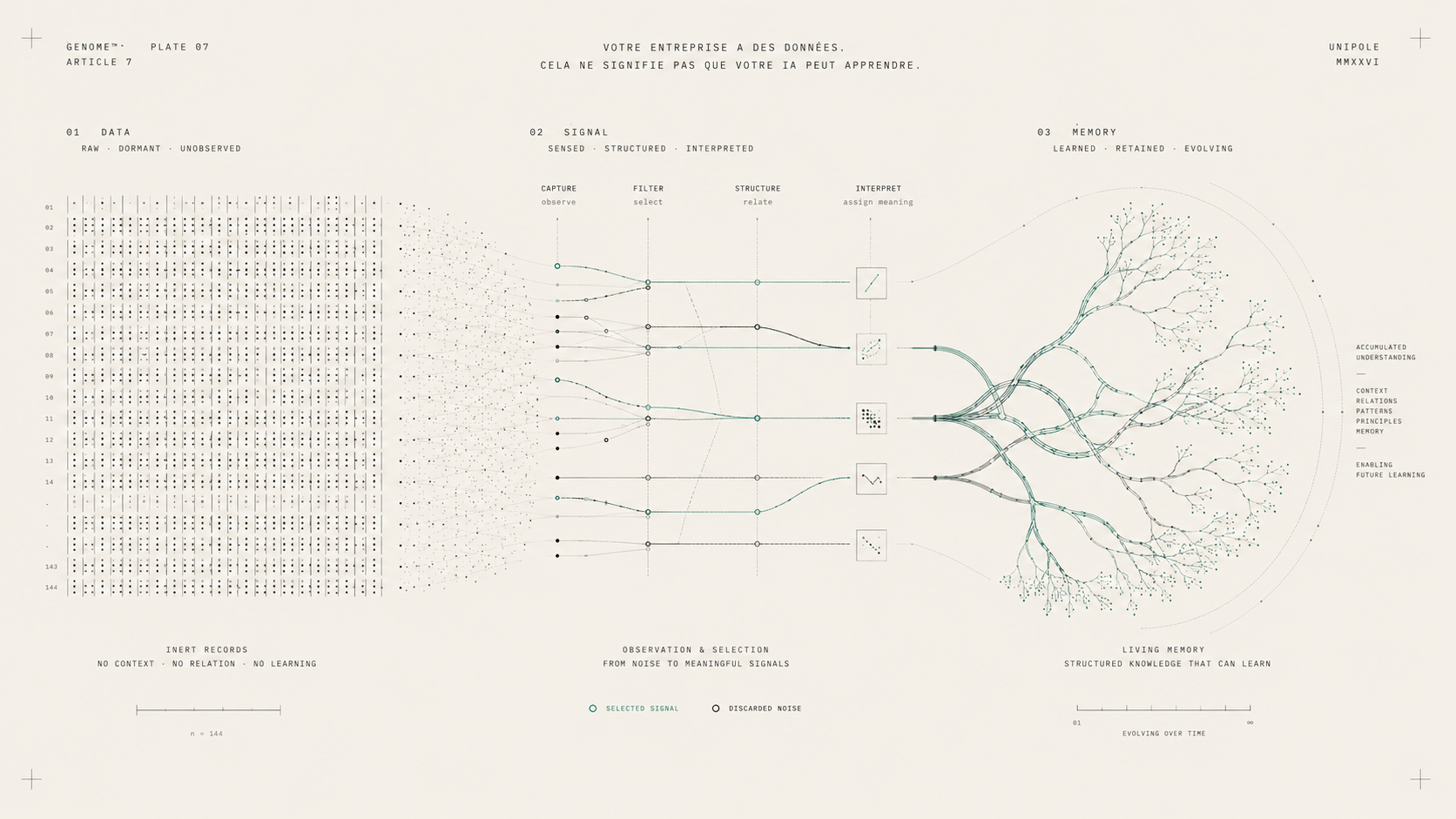
For several years, companies have learned to repeat a phrase that has become almost automatic: “We have a lot of data.”
The phrase is reassuring. It suggests that the company already owns the raw material of artificial intelligence. It creates the impression that connecting a model, a few APIs, a chatbot or an analytics layer will be enough to turn that asset into a strategic advantage.
In practice, many AI projects fail at precisely this point. Not because companies lack data, but because they confuse three very different things: data, signals and learning.
Data describes what exists. A signal reveals what is happening. Learning begins only when the system can interpret that signal, remember it and reuse it.
This distinction is decisive. It explains why some organisations, despite years of history, thousands of customers, millions of database rows and sophisticated dashboards, still cannot build truly differentiated AI.
The dormant-data trap
A company may have a full CRM, sales histories, support tickets, application logs, browsing data, transactions, reports, emails, internal documents, product records and documented business processes. All of this has value. But it does not automatically constitute a learning system.
Most enterprise data was structured for operational purposes: displaying, billing, tracking, reporting, justifying and auditing. It was not designed for learning.
A “customer status” field tracks a commercial relationship, but it does not explain why a customer hesitates. A satisfaction score records an overall feeling, but it does not reveal exactly what created satisfaction or frustration.
A purchase history shows what was bought, but not always what was compared, ignored, abandoned or rejected. A dashboard shows what happened, but not necessarily what should have been captured while it was happening.
This is what I call dormant data. It exists, it is stored, it may be clean and plentiful, but it is not enough to produce useful intelligence.
The real issue: what the system observes
AI does not improve simply because a company owns a large amount of data. It improves when the surrounding system knows how to observe the right phenomena.
Many projects begin with: “Which model will we use?” A better question is: “What can our system observe today?”
- Does it observe only final actions, or hesitation as well?
- Does it observe only success, or abandonment too?
- Does it observe what users say, or what they actually do?
- Does it capture only explicit requests, or also the weak signals preceding a decision?
- Does it record a conversion, or understand the path that led to it?
This is where a system’s AI maturity truly begins: not when the model is connected, but when the organisation decides what the system must be able to perceive.
An interaction is not necessarily a signal
Every company measures things: page views, clicks, email opens, transactions, time spent, conversion rates, tickets and submitted forms. But measuring an interaction does not yet produce a usable signal.
A click is a trace. A click in a specific context, after hesitation, on a given option and following three previous rejections becomes a signal.
An abandonment is a statistic. When connected to a stage, price, offer type, profile, usage sequence and history, it becomes a signal.
The difference is not quantitative. It is architectural. A conventional system accumulates events; a more mature system turns those events into learning material.
Negative signals are often the most valuable
A common mistake is to capture only what works: what is clicked, bought, approved, rated positively or completed. This is understandable, but insufficient.
To learn, a system must also understand what does not work: what a user ignores, rejects, removes, abandons, corrects or no longer wants to see.
Rejection is intelligence material. In many architectures it disappears: it is neither captured, qualified nor remembered. The system knows what was chosen, but not what was discarded.
A customer who does not buy may be signalling price, timing, complexity, trust, poor targeting or an unsuitable context. A user closing a recommendation may be telling the system that it misunderstood the need.
A system that fails to capture these signals remains partially blind. AI connected to a blind system does not become intelligent; it merely accelerates an incomplete understanding.
Data must become memory
Capturing signals is not enough. They must also be remembered properly. Many systems retain histories without building living memory.
History is an accumulation. Memory is an actionable representation.
History says: “this is what happened.” Memory says: “this is what we understood, what appears stable, what changed, what remains uncertain and what should influence the next decision.”
In a mature AI product or system, memory is more than an archive. It must change the future experience.
If the system learns that a user consistently rejects a certain type of proposal, that information should influence future recommendations. If it learns that a process repeatedly fails at a specific step, that memory should reduce future risk.
Learning that never returns to the experience is not learning. It is a lost observation.
Why many AI projects remain superficial
Many current AI projects remain superficial because intelligence is added at the end. The product, process, data and tools already exist; then an AI layer is placed on top.
This approach can deliver quick gains in summarisation, classification, generation, search and assistance. But it soon reaches a limit: the system was not designed to learn.
It may analyse existing data without producing the signals it will need tomorrow. It may automate tasks without building durable memory. That is why many AI initiatives impress initially and then plateau: they use AI, but they do not become learning systems.
The strategic question to ask
Before launching a new AI project, do not ask only: “Which model will we use?” Ask: “Which signals must our system learn to capture?”
- Which interactions are currently invisible?
- Which rejections are not remembered?
- Which user corrections are lost?
- Which behaviours contradict stated intentions?
- Which events are stored but never interpreted?
- What living memory does the system actually build?
- How does what is learned return to the experience?
These questions are less spectacular than an AI demo, but far more structural. They determine whether the company is building an AI feature or an advantage that improves over time.
What GENOME™ helps clarify
One role of the GENOME™ AI Framework is to distinguish systems where AI is merely added from those where intelligence becomes constitutive.
GENOME™ looks beyond the presence of models, chatbots or automations. It examines the system’s ability to:
- structure data for learning;
- turn interactions into signals;
- build living memory;
- make learning actionable;
- reinject learning into the experience;
- create an advantage that strengthens through use.
This changes how a product, platform or information system is designed. It requires a shift from feature logic to organism logic.
A mature AI system is not merely one that answers better. It observes better, learns better, remembers better and improves better.
A company’s true AI asset
A company’s AI asset is not simply the volume of its data. It lies in its ability to turn usage into understanding.
A company with abundant data but few usable signals remains fragile. One that captures, interprets, remembers and reuses the right signals gradually builds an advantage that is harder to copy.
A competitor can buy the same models, use the same APIs, hire similar talent and reproduce visible features. But it cannot instantly copy what your system has learned from its interactions, errors, corrections, rejections, successes and real-world outcomes.
That is where the difference between useful AI and defensible AI is built.
Conclusion
The question is not: “Do we have enough data to do AI?” The real question is: “Is our system designed to turn what it observes into lasting learning?”
If the answer is no, the company can still launch AI projects, but it should recognise that it is primarily building features.
If the answer is yes, it begins to build something else: a system that grows through use, learns from the field, capitalises on interactions and becomes progressively harder to catch.
The future of AI will not be decided by models alone. It will be decided by the quality of the systems capable of giving those models something intelligent to learn.
GENOME™ is a framework for designing and auditing AI-native systems, created and formalised by Hakim Lourguioui and deployed through Unipole consulting engagements. © 2026 — GENOME™ / Unipole. All rights reserved.
Assess your system
Would you like to assess whether your product, platform or information system is truly ready for AI? Unipole helps organisations audit, prepare and transform their systems towards useful, integrated and durable AI.
Is your system ready to learn?
Use the GENOME™ DNA Test to prepare a structured diagnosis.
Take the DNA Test