
It reveals whether your system knows how to use it
AI does not replace expertise
The Ford case shows that AI cannot compensate for lost expertise. It becomes valuable when human knowledge is captured, structured and reinjected into a learning system.

Hakim Lourguioui
Creator of the GENOME™ AI Framework
Published July 10, 2026 · 7 min read
Ford recently delivered a lesson many companies will have to learn in turn.
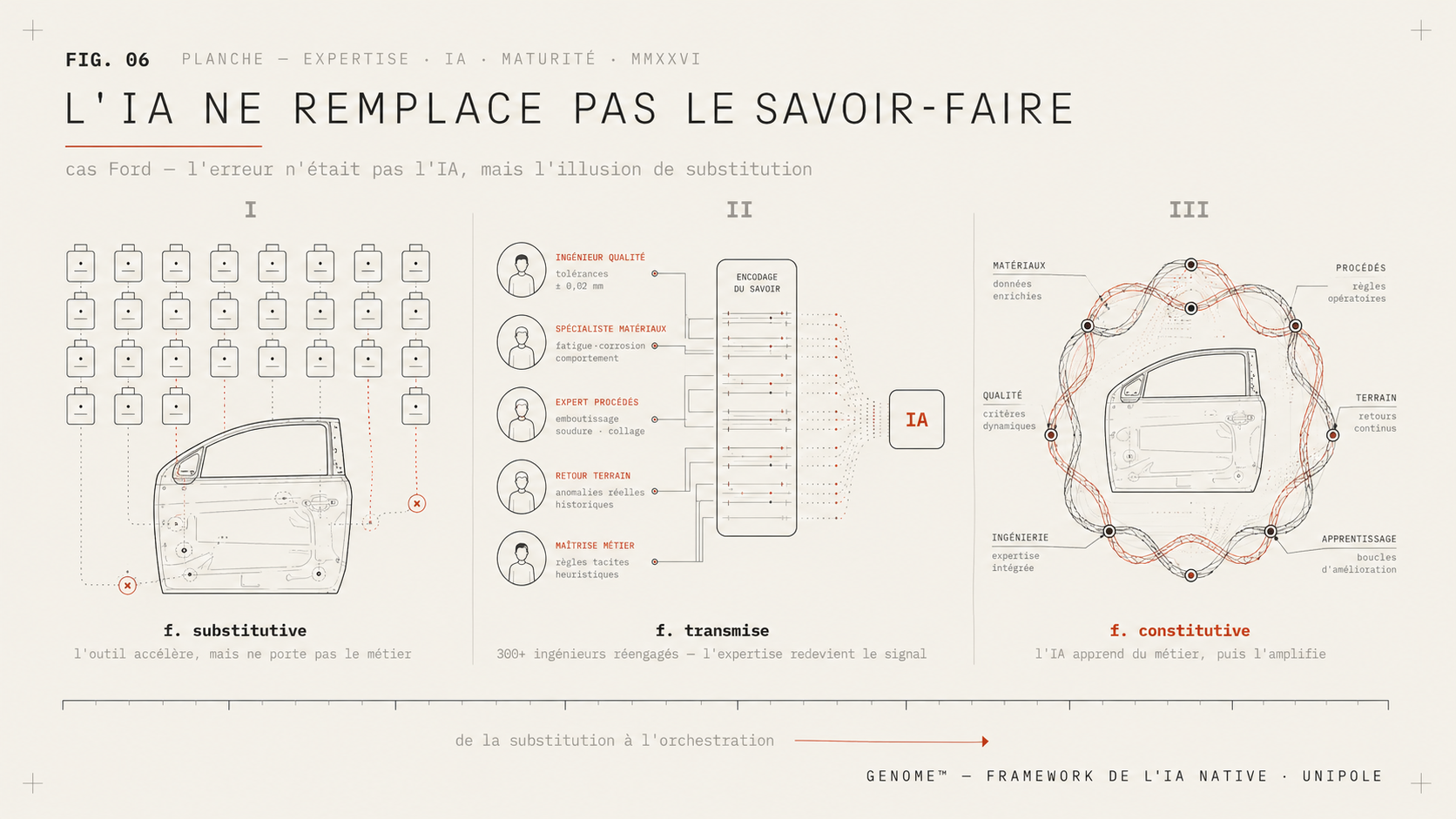
After investing heavily in automation and AI to improve quality processes, the manufacturer brought back several hundred experienced engineers. The objective was not to abandon AI, but to reinject what AI alone did not sufficiently carry: business experience, tacit judgement, product-cycle memory and the ability to detect risks before they become industrial defects.
This case is often misread as evidence that AI does not work. That is too simplistic. The real issue is not the failure of AI, but the failure of a particular way of thinking about AI.
The false debate: AI versus humans
Many companies approach AI as a substitution tool. The implicit question becomes: how many people can we replace?
This is a dangerously poor question. It reduces AI to cost cutting and treats human expertise as a stock of tasks, when it is often a system of judgement, memory, technical intuition and contextual understanding.
In industry, finance, healthcare, digital products and information systems, expertise is not limited to applying rules. It also means recognising what falls outside the rules.
Using AI is not the mistake
The mistake is not putting AI into a system. It is believing that introducing AI automatically absorbs decades of expertise.
A model can process vast volumes, accelerate analysis, detect patterns, generate hypotheses and assist decisions. But it becomes genuinely useful only when the surrounding system knows what to transmit, what to observe, what to learn, what to prohibit and how to correct interpretation.
A company can have the best models, tools and budgets, yet still produce fragile AI if its architecture cannot capture business expertise.
Human expertise must become a system asset
It is not enough to put experts around AI. Their expertise must become structural material for the system.
Human knowledge should not remain confined to people’s heads, meetings, habits or exceptions known by a few senior employees. It must progressively become usable by the system.
- Actionable data.
- Decision rules.
- Field signals.
- Quality criteria.
- Correction loops.
- Organisational memory.
- Guardrails and human review for critical areas.
The grafted-AI trap
In many organisations AI is still grafted on. A tool is added, a model connected and part of the process automated, only for the company to discover that the system does not understand the real context well enough.
AI was added at the end. It was not designed into the system’s architecture: its data, exceptions, trade-offs, histories, weak signals, corrections and field feedback.
It executes but does not learn enough from the business. It accelerates but does not carry the knowledge.
What GENOME™ seeks to distinguish
GENOME™ does not begin with “where can we add AI?” It asks a harder question: how must the system be designed so intelligence becomes constitutive, learning and defensible?
This changes everything. The focus moves beyond AI features to data architecture, captured signals, system memory, learning loops and the role of people in correction, validation and governance.
Durable AI is measured not only by what it produces today, but by what it learns, remembers and improves tomorrow.
The real human role in a mature AI system
In an immature system, people are treated as a cost to reduce. In a more advanced system they become supervisors. In a truly mature system they become a structural source of intelligence.
People do more than validate or correct AI. They help train the system, enrich its memory, qualify errors, identify blind spots and transmit what data alone does not yet reveal.
AI does not replace expertise. It can amplify expertise, provided that knowledge is captured, structured, transmitted and reinjected into the system.
The right question for an AI committee
When the next AI initiative is presented, do not ask only how much it will automate. Ask which human expertise the system will learn to carry.
- Which business decisions must remain under human control?
- Which field signals will be captured?
- Which errors will become learning?
- What memory will be built?
- Which experts will train, correct or enrich the system?
- What will the system know in six months that it does not know today?
The Ford lesson
The Ford case does not say that AI is useless. It says the opposite: AI becomes genuinely useful when it is fed by expertise, integrated into critical processes, governed by review loops and connected to business memory the organisation knows how to preserve.
The future will not be AI versus humans. It will belong to organisations capable of turning human expertise into a learning system.
That is where genuine AI maturity lies: distinguishing added AI from constitutive AI, opportunistic automation from durable intelligence, and naive substitution from mature orchestration.
Is your system ready to learn?
Use the GENOME™ DNA Test to prepare a structured diagnosis.
Take the DNA Test